
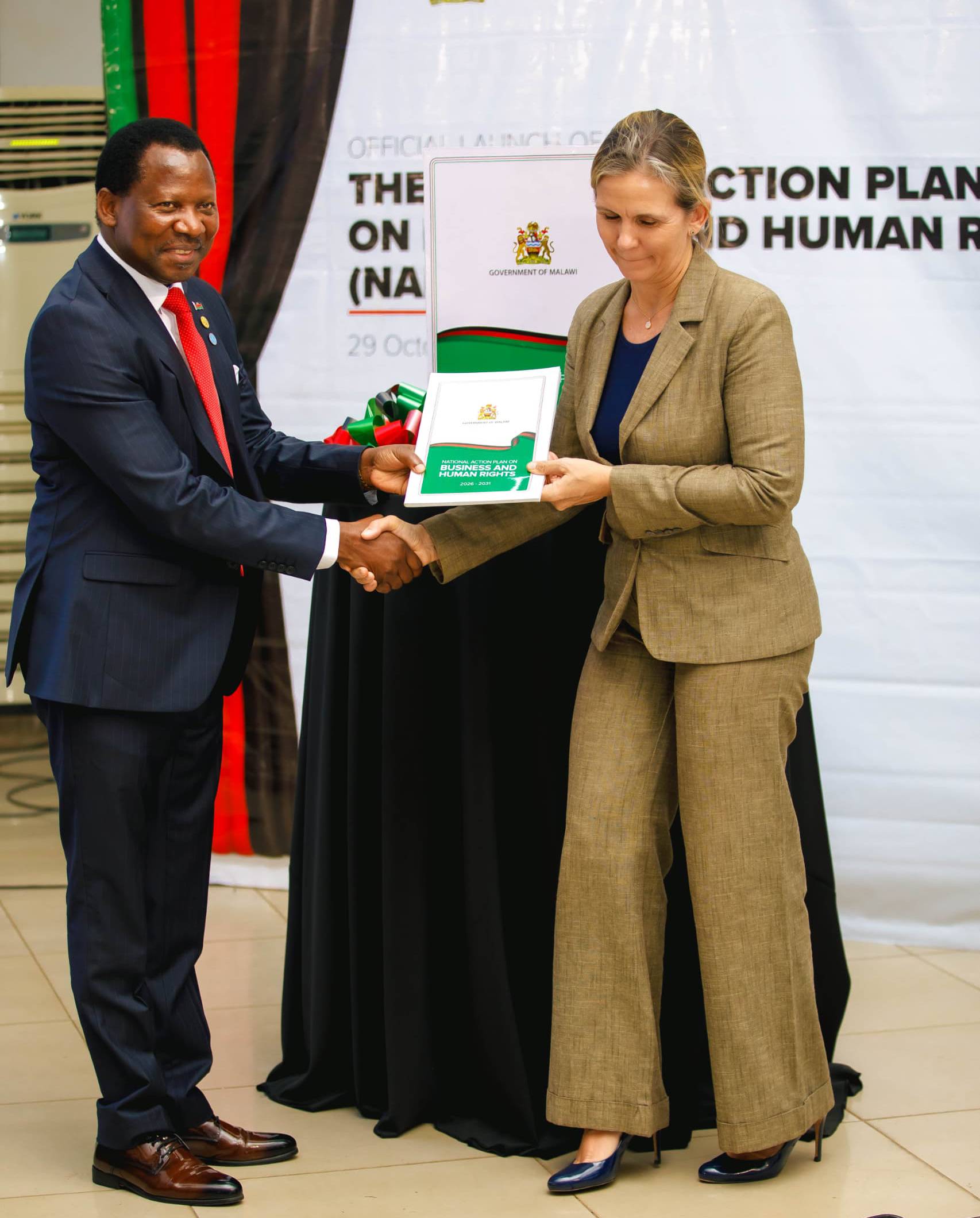
Malawi has today launched its National Action Plan on Business and Human Rights (NAP-BHR 2026 - 2031) in Lilongwe. Anchored in UN principles, the framework balances national economic growth with strict safeguards for human rights.
Developed through multisectoral consultations and a national baseline assessment, the plan has been launched by Minister of Justice and Constitutional Affairs, Charles Mhango, and it targets high-risk sectors. Key focus areas include mining, agriculture, tourism, and construction to address critical gaps in human rights protections.
The Ministry of Justice and Constitutional Affairs coordinates the implementation, supported by the presidency and the Malawi Human Rights Commission. Officials urged the business community to embrace the plan to boost investor confidence and reduce risks.
Mhango told the gathering His Excellency President Arthur Peter Mutharika endorsed the plan.
Presenting an overview of the plan ahead of the launch, Chief State Advocate in the Ministry of Justice and Constitutional Affairs, Duncan Zikagwa, highlighted that the plan is anchored in the United Nations Guiding Principles on Business and Human Rights (UNGPs), adopted in 2011, which provide a framework for protecting human rights in business operations.
"There are three pillars of the principles: the State duty to protect human rights, the corporate responsibility to respect human rights, and access to effective remedies for people affected by business-related human rights abuses," Zikagwa said.
Zikagwa emphasised that the development of the NAP-BHR is not a single-institutional task but a multisectoral effort, noting that the process involved consultations with government institutions and other private stakeholders to establish priority actions.
"The development of the NAP-BHR followed a national baseline assessment that examined Malawi’s legal, policy and institutional frameworks, identified gaps in human rights protection and mapped business-related human rights risks in key sectors, including mining, agriculture, tourism and construction," said Zikagwa.
On implementation, Zikagwa highlighted the roles of key institutions, including the Ministry of Justice and Constitutional Affairs as the lead coordinating institution, the Office of the President and Cabinet in providing political leadership, and the Malawi Human Rights Commission in monitoring implementation and handling complaints.
Zikagwa further urged the business community to view the plan as an opportunity to strengthen business performance rather than as a punitive government intervention, arguing that responsible business conduct can improve investor confidence, reduce operational risks and strengthen relationships between companies, communities and regulators.
Following the presentation, Zikagwa led a panel discussion under the theme “Responsible Business in Practice,” in which Panellists shared perspectives from their respective areas of work and made commitments and recommendations aimed at promoting responsible business conduct and strengthening the protection of human rights in business operations.
- 11 views